Why We Need to Focus on Building Passive Income For a Secure Financial Future
Artificial Intelligence (AI) has been around since the 1950s, but its popularity has risen dramatically since November 2022 when ChatGPT came out. Some believe that what the internet was in 1995 is what AI is in 2024. ChatGPT has barely been around for slightly over a year and already has around 180.5 million active users as of January 2024 (Duarte, "Number of ChatGPT Users," Exploding Topics).
The following chart from Exploding Topics does a good job of putting ChatGPT's popularity into perspective:
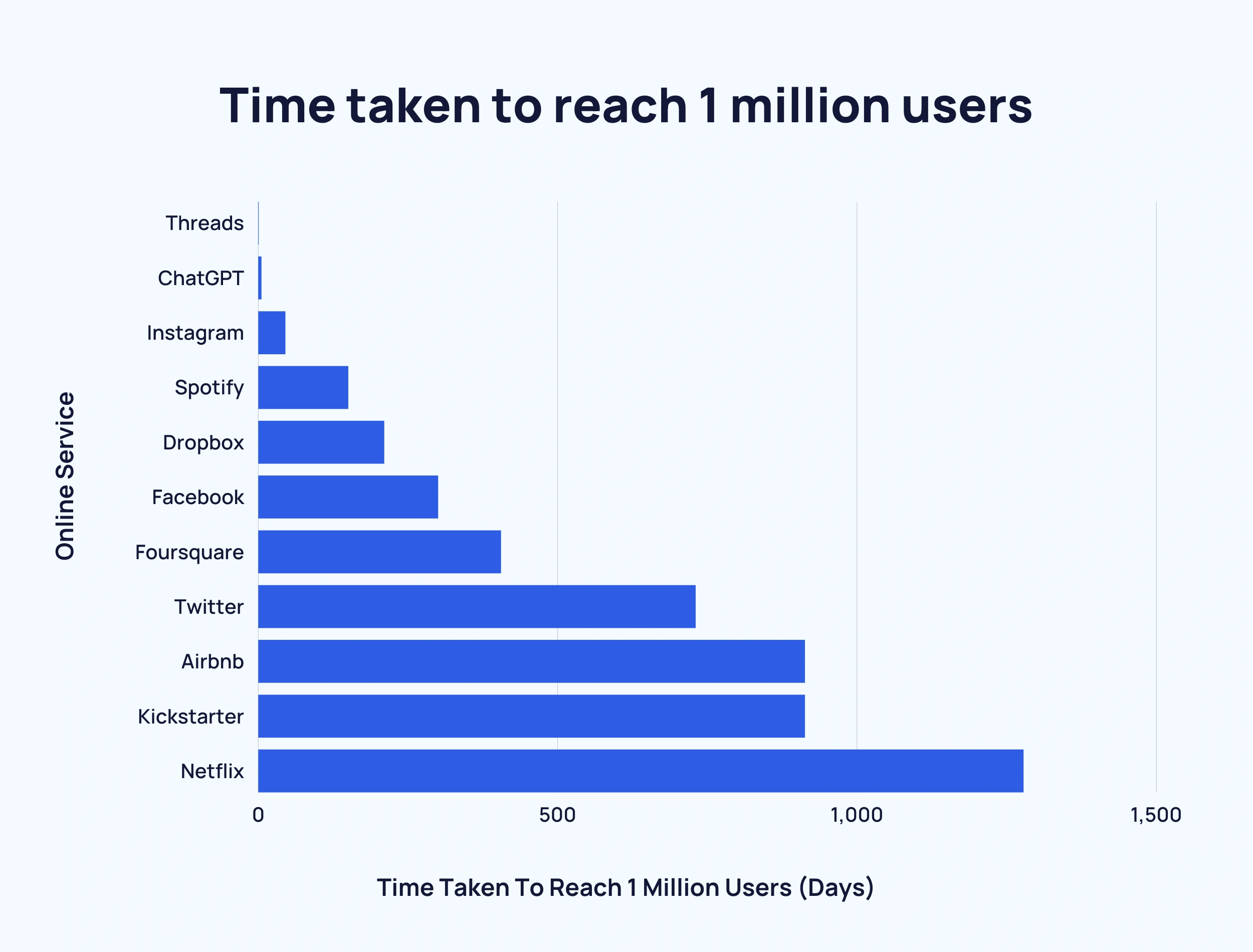
Figure 1: Time It Took Different Platforms to Reach One Million Users (Source: Exploding Topics)
According to the article, "Number of ChatGPT Users" in Exploding Topics, it took only five days for ChatGPT to reach one million users. To put things in perspective, the article states that it took Instagram approximately 2.5 months to reach one million users, while it took Netflix around 3.5 years to do so. ChatGPT is only the beginning - one can only begin to imagine how popular AI is going becoming in the upcoming years.
In the chapter one of his book, "How to Build a Secure Financial Future in the Age of Artificial Intelligence," Scott Gamm explains that because AI is slowly becoming more popular and could potentially threaten our jobs in the future, individuals need to focus on building more passive income. Gamm defines passive income as money you receive from not having to work. Examples of passive income include investing in the stock market, blogging, real estate investment trust, teaching an online course, etc. Gamm states that having a good amount of passive income means having strong financial independence. Gamm isn't stating that individuals should give up their typical 9am to 5pm job, but having enough passive income means people won't automatically be in deep trouble if they get laid off.
Gamm begins by explaining how robots have become quite popular over the past few years. Robots are capable of performing tasks that are too tedious, boring or painful for humans to do. Additionally, using robots can be cheaper, robots don't get sick, they work faster, don't need breaks, and can work for long hours without complaining. For these reasons, employers are eager to use robots to complete day-to-day tasks. In December 2018, the CEO of Virgin Galactic, Richard Branson explained how companies will be less reliant on people power and more on machines. Driverless cars, advanced drones, robots and machines will all become popular. The "Future of Jobs Report 2018" from the World Economic Forum states that as of 2018, twenty-nine percent of tasks are completed through machines, whereas by 2025, more than half the number of tasks will be completed through machines. Fortunately, the report also proceeds to say that AI will create 133 million new jobs and displace only 75 million, so the overall outlook is still positive. However, it doesn't change the fact that it is important for people to continue building passive income. The CEO of Deutsche Bank, John Cryan told Financial Times that a large percentage of his 97,000 employees would lose their jobs because they simply won't need that many people in the future.
Gamm also goes onto explain that companies are investing large amounts of money to retraining their employees for the rise of new AI technologies such as machine learning, robotics, cloud computing and more. In March 2019, JP Morgan Chase planned to spend $350 million to prepare workers for the future of AI in daily job functions. In July of the same year, Amazon spent $700 million to retrain over 100,000 employees. PwC has been spending over $3 billion over the past couple of years to upskill its employees.
The key takeaway is that while the future of AI is exciting, it also threatens to put many people on the unemployment line. That is why it is important for people to start building up their passive income. They can do this by investing in the stock market, monetizing a YouTube channel, running a part-time business, etc. Passive income will act like a collateral in case people lose their jobs, and will allow individuals to have financial independence, so they can continue to provide for themselves and their families.
References:
Gamm, Scott. “Financial Independence and Artificial Intelligence.” Overcome AI: How to Build a Secure Financial Future in the Age of Artificial Intelligence, Nicholas Brealey Publishing, Boston, 2020.
Duarte, Fabio. “Number of CHATGPT Users (Mon 2024).” Exploding Topics, Exploding Topics, 5 Jan. 2024, explodingtopics.com/blog/chatgpt-users.
Comments
Post a Comment